
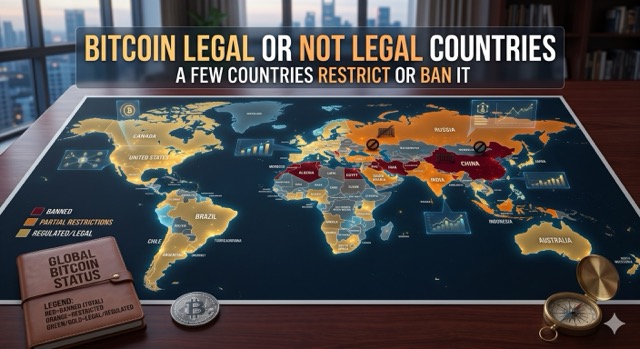
The Global Crypto Fracture: Where Bitcoin is Welcomed, Restricted, or Banned
The Global Crypto Fracture: Where Bitcoin is Welcomed, Restricted, or Banned
When Bitcoin first burst onto the scene, governments struggled to classify it. Was it a currency, property, or a passing tech fad? Today, the global stance on Bitcoin is highly fragmented. While major economies have integrated digital assets into their mainstream financial systems, a distinct group of nations has chosen a completely different path-restricting or outright banning its use.
Understanding this split is essential for anyone navigating the modern digital economy.
The Absolute Bans: Where Crypto is Fully Illegal
In these jurisdictions, the state has drawn a hard line. Operating an exchange, mining blocks, or even possessing Bitcoin as an individual is considered a legal violation that can carry harsh financial or criminal penalties.
China: The most high-profile absolute ban. China has completely outlawed all crypto transactions, trading, and mining operations, focusing its state efforts entirely on its own sovereign digital currency (the digital yuan).
Algeria: Enacted a strict financial law that makes it entirely illegal to buy, sell, use, or hold any form of virtual currency.
Egypt: Egypt’s central banking laws prohibit the trading, issuing, or promoting of crypto without a highly restrictive central bank license. Additionally, major local religious decrees have classified Bitcoin transactions as prohibited under Islamic law.
Bangladesh: The central bank considers cryptocurrency an unauthorized transaction tool, treating its use as a violation of strict anti-money laundering and foreign exchange laws.
Nepal: The Nepal Rastra Bank declared Bitcoin and other digital assets completely illegal, actively cracking down on local trading networks.
Iraq: The Iraqi Central Bank maintains a hostile stance, prohibiting local brokerage firms, citizens, and banking institutions from handling any virtual currencies.
Other Total Bans: Afghanistan, Kuwait, Morocco, Tunisia, and North Macedonia also enforce strict prohibitions against digital asset ownership and trading.
The Partial Restrictions: The Implicit Gray Zones
In these countries, Bitcoin is not entirely outlawed, but governments have cut off the "bridges" to the traditional financial system. Usually, individuals are allowed to hold or trade crypto as an asset or commodity, but they face heavy legal and financial guardrails.
Russia: While citizens are allowed to buy and hold Bitcoin as an investment asset, strict laws ban the use of digital assets as a valid payment method for any goods or services within the country.
Turkey: The central bank explicitly bans using cryptocurrencies directly or indirectly for payments. While crypto exchanges still operate, traditional banks are barred from facilitating crypto-to-fiat transactions seamlessly.
Indonesia: The government classifies cryptocurrency strictly as a commodity that can be traded on regulated futures exchanges, but using it as legal tender or a commercial payment tool anywhere in the country is illegal.
India: Crypto is legal to hold, but the government treats it with severe economic friction. This includes a heavy 30% flat tax on all crypto capital gains and a 1% Tax Deducted at Source (TDS) on every transaction to track asset movement.
Saudi Arabia: The Saudi Central Bank has issued strict warnings against crypto trading and bars local banking systems from supporting or processing unauthorized crypto-related transactions.
The Legal Landscape at a Glance
The following summary outlines the exact structural differences between these two regulatory approaches:
Status TypeWhat is Blocked? Core Government GoalAbsolute Ban Ownership, Mining, Local Trading, Payments, and Crypto Exchanges.Complete monetary control and prevention of capital flight.Partial RestrictionUse as legal tender/currency, bank transfers to exchanges, or commercial payments.Protecting the local fiat currency while containing financial risk.
The Other Side: Regulated & Crypto-Friendly Zones
In sharp contrast to the nations restricting it, the vast majority of the world has opted for a regulated framework. Some regions have even positioned themselves as global hubs by offering clear rules and attractive tax policies.
The Regulatory Heavyweights: The United States, Canada, and the United Kingdom treat Bitcoin as property or a financial asset. They heavily regulate exchanges to protect consumers and enforce capital gains taxes on profits.
The European Union (MiCA): The EU stands out for its Markets in Crypto-Assets (MiCA) regulation, a unified framework that brings legal clarity and strict compliance standards across all member states.
The Global Tax Havens: Countries like Switzerland (home to the famous "Crypto Valley" in Zug), the UAE, and Singapore have built highly predictable, business-friendly legal environments to attract global tech talent and investments.
The Takeaway
Bitcoin is far from universally accepted, but it is also far from universally banned. Instead, the world has divided into distinct legal zones. As market frameworks mature, the gap between crypto-friendly hubs and nations restricting its use continues to widen, making local legal awareness a must for any global crypto holder or digital business.
0 Comments
Join the conversation
Sign in to comment